
SEO Content Strategy in Portland
Great content doesn’t just fill your website—it attracts customers, answers their questions, and signals to Google that your business deserves to rank. A strategic content and copywriting approach goes beyond generic blog posts or keyword stuffing. It involves creating purposeful, high-quality content that aligns with what your audience is actually searching for while building topical authority that Google rewards with higher rankings. From service pages and location-specific content to educational resources and conversion-focused sites, the right content strategy transforms your website into a customer-generating asset that performs in both traditional search and AI-driven discovery.
Landing Page Copywriting
The words on your landing page determine whether visitors become customers or click back to your competitors. Professional landing page copywriting goes beyond simply describing your services; it’s strategically crafted to match search intent, build immediate trust, and guide visitors toward taking action. When done right, optimized copywriting speaks directly to your audience’s needs, incorporates the keywords Google rewards, and converts traffic into leads by making your value proposition clear, compelling, and impossible to ignore.

Topic Clusters
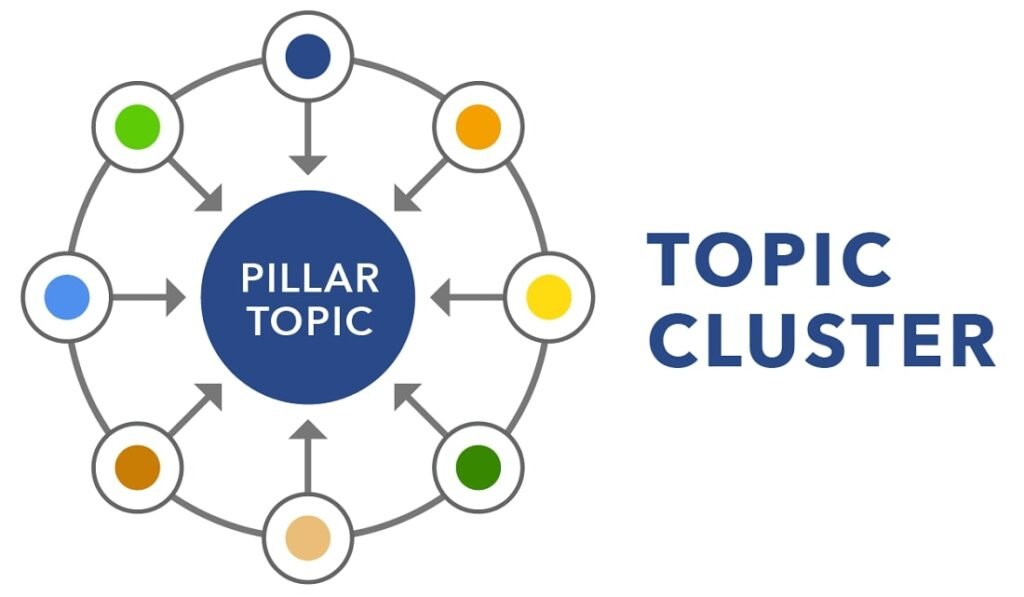
Topic clusters are the modern framework for how search engines understand and reward content authority, yet most websites still publish isolated blog posts that never gain traction. A strategic topic cluster organizes your content around core themes, with pillar pages covering broad subjects and supporting articles diving into specific details, all interconnected through smart internal linking. This structure signals to Google that you’re a true authority on your topics, boosting rankings across entire subject areas rather than just individual keywords, and making it easier for both search engines and visitors to find exactly what they need.
Content Refreshing
Even high-performing content loses rankings over time as information becomes outdated, competitors improve their pages, and Google’s algorithms evolve. Content refreshing is the strategic process of updating existing articles and pages with new information, improved optimization, and enhanced user experience to reclaim and even increase search visibility. Rather than constantly creating new content from scratch, refreshing leverages the authority and backlinks your pages have already built, often delivering faster ranking improvements and better ROI than publishing something entirely new.

How we approach the work
Four stops, in this order. You will always know which one your project is in and what comes after it.
-
Audit
Search Console first, for what Google has already indexed and what is already ranking, because that is what decides which pages get refreshed and which get written from scratch. Then your pages and your sitemap. Local Falcon on top of that if you are chasing a map pack as well.
-
Strategy
The audit tells us which job this is. A clean site is weeks of work. One that has been neglected or built badly is months. You get the order we would go in, and why, before anything is touched.
-
Build
Pages written, structure fixed, profile tuned, listings corrected. The order comes from the audit, so nothing gets changed on a hunch.
-
Report
One page a month. Where you rank and where you sit in the map pack, exactly what was done that month, and what comes next.
- +250% Qualified leads for a window cleaning company
SEO is one of the most important things a business owner can invest. This company will have you top of mind and top of the game.
Before you get in touch
How much does content strategy cost in Portland?
Three things move the number: the state of the site you already have, how many service areas you want to be found in, and how hard your industry is to compete in around Portland. I cannot know any of them until I have looked. You get a real number on the first call, before you have spent anything.
Can I just use AI to write my content?
You can. Here is why I would not bet your site on it.
The companies building these tools are building the means to recognise their own output at the same time. Google watermarks what its models produce, and Google is the one deciding what ranks. Whether or not anything can be detected today, it is getting easier rather than harder, and the people making it easier are the people you are trying to rank with.
Now the part that is my read rather than a fact. I think Google ships an update that strips out a large amount of AI-written content, and I think the spam updates this year were the trial run for it. I could be wrong about that. But look at the two outcomes. If I am wrong, you published something a machine could not have written. If I am right, the cheapest pages on your site take the rest of it down with them. That is not a close call.
And the thing that ranks is the same thing that gets quoted back inside an AI answer: the part that came from doing the work. A number you measured, a job that went wrong, the two words your customers use that nobody outside the trade would guess. That is not a writing problem, it is a knowing problem.
Should I write new posts or fix the ones I have?
Fix the ones you have, almost always, and almost nobody wants to hear it. A page that already ranks somewhere has history, links pointing at it and a track record with Google. Improving it starts from all of that. A new post starts from nothing and has to earn it again.
I have rebuilt a site, reposted every page in a single day, submitted the sitemap two days later and watched traffic climb three days after that. Five days from starting to seeing it move, on pages that already existed. Nothing new was published.
New content is for a subject you genuinely do not cover yet. If you are writing the fourth post about something you have already covered three times, you are competing with yourself, and the fix is to merge them rather than add to them.
Is SEO better than running ads?
Yes, and I will argue it. Ads stop the day you stop paying for them. Search does not. I am a Yelp advertising partner, which means I see the paid dashboard as well as the organic side, so this is a comparison I have actually watched rather than one I have read about. In the AI era it matters more, not less: generative engine work moves quickly now, and plenty of very large companies have built their entire marketing strategy on being found rather than on buying attention.